How to Choose the Right Social Media Platform for Your Small Business (Without Wasting Time)
Someone, somewhere, told you that you need to be on all of them.
Instagram. TikTok. Facebook. WhatsApp. LinkedIn. YouTube. Maybe even Snapchat if you’re targeting Gen Z.
So you set up accounts on four platforms, posted for three weeks, got inconsistent engagement, burned yourself out trying to keep up — and now you’re posting sporadically on everything and winning on nothing.
That’s not a social media problem. That’s a focus problem.
Choosing the best social media platform for small business isn’t about being everywhere. It’s about being somewhere that actually reaches your specific customer — and showing up there consistently enough to matter.
This guide cuts through the noise. By the end, you’ll know exactly which platform deserves your energy — and which ones you can leave alone without guilt.
The Truth Nobody Says Out Loud
Most social media advice is written for audiences where Facebook is dying, LinkedIn is everything, and WhatsApp is just a messaging app.
That’s not most of our reality.
If your business operates in Africa, the Middle East, or serves a diaspora community, the social media landscape looks different — and the advice needs to reflect that.
WhatsApp is not a messaging app for your business. It is your storefront, your customer service desk, and your most trusted sales channel all in one. Facebook still runs communities in ways Instagram never has. TikTok is not just for dancing — it’s where an entire generation discovers businesses before they ever Google them. And Instagram is where trust is built before the sale is made.
Ninety percent of small business owners in Africa use Facebook, Instagram, and WhatsApp to conduct business. Those aren’t Western platforms adapted for the continent — they’ve become genuinely native to how business gets done here.
But even knowing all of that, you still have to choose. Because doing three platforms poorly will always lose to doing one platform exceptionally well.
Three Questions That Tell You Everything
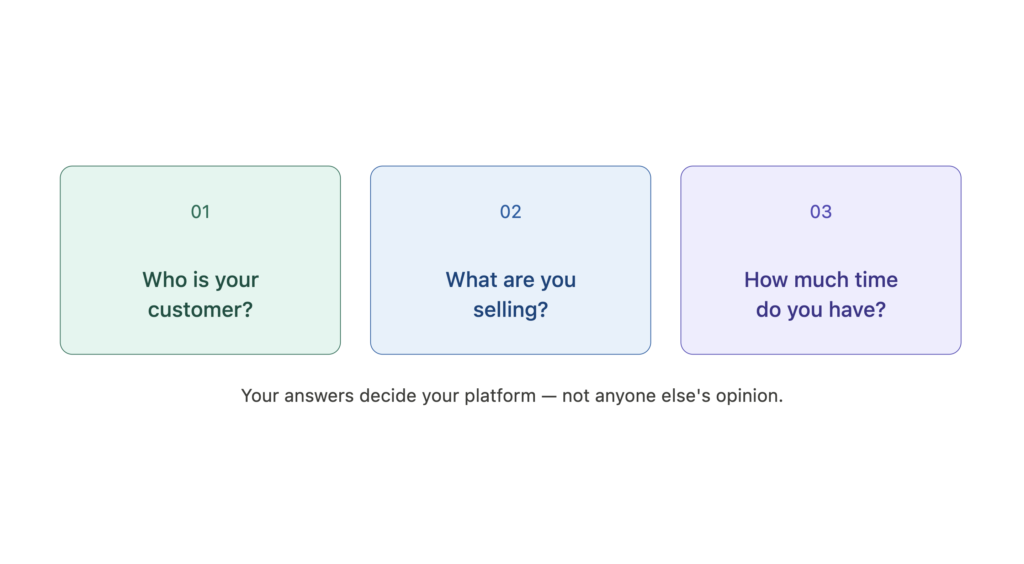
Before we talk about any specific platform, answer these three questions honestly. They will determine your answer more accurately than any “best platform” list.
Question 1: Who is your customer, and how do they discover businesses like yours?
A 45-year-old professional looking for an accountant finds businesses differently than a 22-year-old looking for a fashion brand. One scrolls Facebook and asks in community groups. The other finds you on TikTok or Instagram before they even know they need you. Your customer’s age and behaviour pattern determines where you need to be — not where you personally like spending time.
Question 2: What are you actually selling?
Visual products — fashion, food, beauty, interiors, art — live on Instagram and TikTok. Services that require trust before someone buys — coaching, consulting, finance, legal — build that trust differently on LinkedIn or through WhatsApp communities. Products that need demonstration — appliances, technology, tools — work on YouTube and TikTok. The nature of what you sell should drive the platform choice, not the other way around.
Question 3: How much time do you genuinely have each week?
This is the most honest question and the one most guides skip entirely. Every platform has a different content demand. TikTok needs short video — ideally multiple times a week. LinkedIn rewards long-form written insight. Instagram needs strong visuals consistently. WhatsApp needs personal, responsive communication. If you’re running a business alone with limited hours, the platform that matches your bandwidth is just as important as the platform that matches your audience.
Write down your answers before reading the platform breakdown below. The combination of those three answers will point you somewhere specific.
The Platform Breakdown — For Our Reality, Not Theirs
WhatsApp — Your Closest Customers
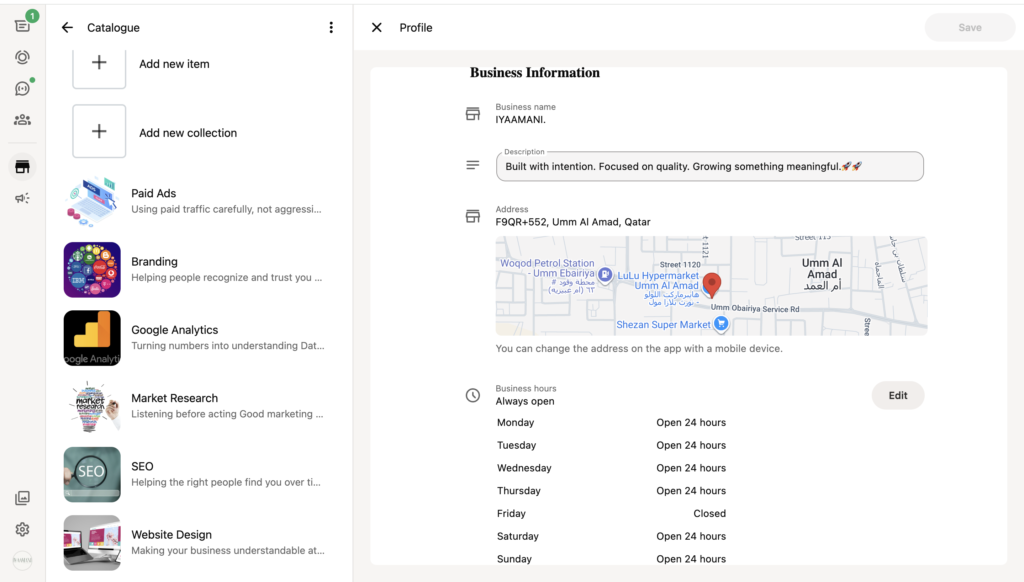
If you do nothing else, use WhatsApp Business properly.
For small businesses serving African and diaspora communities, WhatsApp is where the most valuable relationships happen. It’s where customers ask real questions before they buy, where repeat purchases get confirmed, and where word-of-mouth travels fastest. A message on WhatsApp feels personal in a way that an Instagram comment or a Facebook post never does.
The WhatsApp Business app — free to download — lets you set up a product catalogue, create automated responses for common questions, and build broadcast lists for loyal customers. Used well, it is the most direct sales channel available to a small business at zero cost.
What WhatsApp is not good for: discovery. New customers won’t find you there unless someone they already trust sends them your number. That’s why WhatsApp works best alongside another platform — not instead of one.
Best for: Any business with repeat customers, service businesses, businesses where personal trust drives the sale.
Instagram — Where Trust Becomes Visual
Instagram is where people decide whether they want to know more about you.
Before a customer clicks your website, before they send a WhatsApp message, they look at your Instagram profile. They want to see what you do, how it looks, and whether you feel credible. For any business where the product or service has a visual element — fashion, food, interiors, beauty, events, hospitality — Instagram is where that credibility is built.
The shift toward Reels means video is now the fastest way to grow on Instagram. But the fundamental purpose of the platform hasn’t changed: it’s a portfolio. Your grid tells a story about who you are and what you stand for. Customers make decisions based on that story before they ever reach out.
Instagram is also where the Africa/diaspora middle class discovers aspirational brands. If your customer is urban, 25–40, and has disposable income — they are on Instagram, and they’re making buying decisions based on what they see there.
Best for: Visual products, lifestyle brands, food and hospitality, beauty and fashion, service businesses that want to build credibility through content.
TikTok — The Discovery Engine for a New Generation
TikTok has changed the way a generation finds businesses, and it’s happening faster in African markets than most people realise.
Young adults in Lagos, Nairobi, Accra, and Doha are now typing “best restaurant near me” or “how to start a business” into TikTok before they open Google. The platform has become a search engine as much as an entertainment platform — and for businesses willing to show up authentically on video, the organic reach is still extraordinary compared to any other platform.
The businesses winning on TikTok are not the ones with the best production quality. They’re the ones showing real, honest, behind-the-scenes content — how the product is made, the founder’s story, answers to customer questions, local humour that lands with a specific community.
The honest caveat: TikTok requires consistent video content and genuine creativity. If short-form video feels completely outside your comfort zone and you don’t have the time to find that comfort zone, TikTok is not your starting platform. Start there only if you’re willing to show up for at least three months of consistent content before expecting results.
Best for: Products with a visual story, youth-facing brands, founders willing to be on camera, businesses targeting 18–35 audiences.
Facebook — Community Still Lives Here
Facebook is not dead. It’s just older — and for small businesses, that’s often exactly right.
Facebook Groups remain one of the most powerful community tools available to small businesses. Local buy-and-sell groups, industry communities, neighbourhood networks — these are active, engaged, and full of people making purchasing decisions based on recommendations from people they trust.
For businesses targeting customers aged 35 and above, Facebook is still where your audience is most active. For local businesses — restaurants, service providers, retail — a well-maintained Facebook Page with consistent posts and active responses to comments builds community visibility that Instagram and TikTok simply don’t replicate.
Facebook also gives you access to Meta Ads Manager, which remains the most powerful paid advertising tool for reaching specific audiences at small budgets — a topic covered in depth in the paid ads for beginners guide.
Best for: Local businesses, businesses targeting 35+ audiences, community-based marketing, anyone planning to run social media ads.
LinkedIn — For the Business Behind the Business
LinkedIn is not for every small business. But for the right ones, it is the highest-value platform available.
If your customer is another business — or if your customer is a professional making decisions in a professional context — LinkedIn is where you build the credibility that converts. A well-written post on LinkedIn from a founder who understands their industry reaches decision-makers in a way that an Instagram Reel simply cannot.
For consultants, coaches, financial services, legal services, marketing agencies, and anyone selling to other businesses — LinkedIn is where trust is built before a single meeting is ever requested.
Best for: B2B businesses, consultants, coaches, service professionals, anyone whose customer thinks of themselves as a professional first.
Applying the Framework: What Your Answers Tell You
Now go back to your three answers.
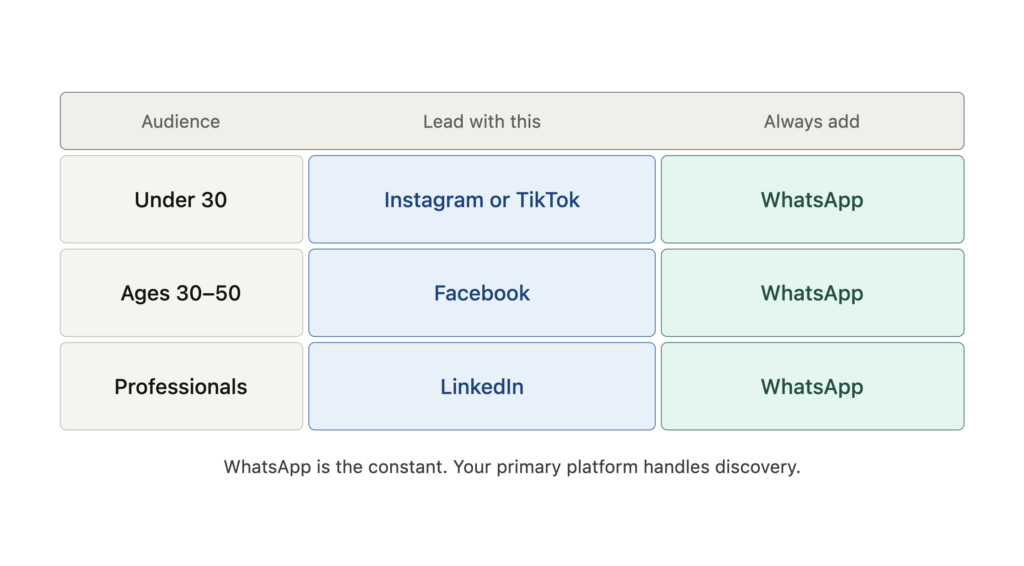
If your customer is under 30, discovering businesses on their phone, and you’re selling something visual — Instagram plus TikTok, with WhatsApp for follow-up conversations.
If your customer is 30–50, makes decisions based on community recommendations, and you’re selling a local service — Facebook plus WhatsApp. Full stop.
If your customer is a business or professional, and the sale requires a relationship before money moves — LinkedIn plus WhatsApp for direct follow-up.
If you’re not sure who your customer is yet, that’s not a social media problem — that’s a market research problem, and solving it first will save you months of wasted content creation.
The one rule that applies everywhere: pick one primary platform and one supporting platform. Show up on the primary one consistently enough that people start to recognise you. Use the supporting one for conversion and relationship-building. Add more only when the first two are genuinely working.
Every platform you add before that point just dilutes your energy and produces weaker results across the board. Focus is not a strategy limitation. It’s what makes the strategy work.
For a broader view of where social media sits inside your full digital marketing strategy, and how it connects to SEO, paid ads, and branding, that guide covers the full picture in the same plain-language approach.
If You’re Still Not Sure
Pick WhatsApp and one other platform based on your customer’s age.
Under 30: WhatsApp + Instagram or TikTok. 30–50: WhatsApp + Facebook. Professionals or B2B: WhatsApp + LinkedIn.
Start there. Post consistently for 90 days. Watch where the engagement comes from, which platform drives conversations, and which one generates actual business enquiries. Let the data make the next decision for you — not another article, not another person’s opinion, and not the pressure of seeing a competitor on a platform you haven’t touched yet.
Your branding consistency across whatever platforms you choose matters more than which platforms you pick. A consistent name, image, and tone of voice across two platforms builds more trust than an inconsistent presence across six.
One Question Before You Go
Every business reading this is in a different situation. Some are spread across five platforms and exhausted. Some have never posted consistently anywhere. Some are already doing well on one platform and wondering if they should expand.
Which platform are you currently most active on — and is it actually bringing you customers, or just followers?
Drop your answer in the comments. I read every one and I’ll tell you directly whether to stay, double down, or shift.
If you’d like help building a focused social media strategy for your specific business — one that matches your audience, your product, and your real bandwidth — let’s talk. No generic advice. Just a conversation about what actually makes sense for where you are.