
Paid Ads for Beginners: How to Start Without Burning Your Budget
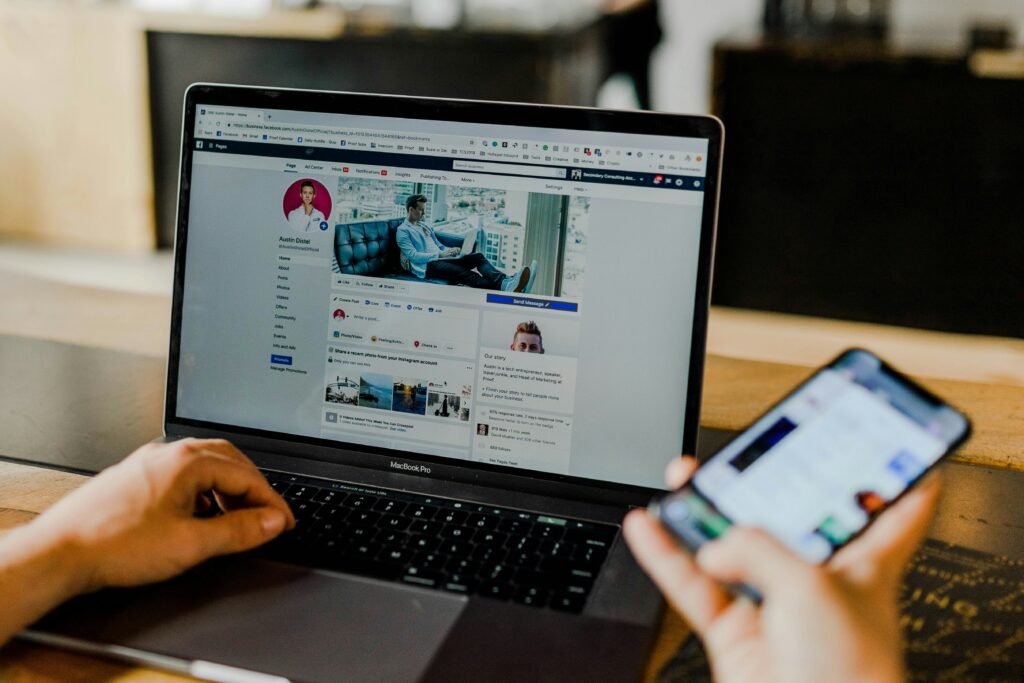
You boosted a post once. You spent the money, watched the reach number go up — and got nothing back. If you’re looking for a real guide to paid ads for beginners, this is it: no hype, no fluff, just what you actually need to know before spending a single cent. Maybe it was on Facebook. Maybe Instagram. You put in twenty, thirty, fifty dollars, watched the “reach” number go up, and waited.
And then nothing. Calls. Messages. Customers. Just a lighter wallet and a lot of confusion.
So now you’re sitting with the same question most small business owners carry around: do paid ads actually work — or is it just money disappearing into the internet?
The honest answer is both. And the difference between the two has nothing to do with your budget. It has everything to do with how you set it up.
This is a guide to paid ads for beginners who want to start smart — not spend big and hope for the best.
What Paid Ads Actually Do (And What Most Beginners Misunderstand)
Paid advertising does one thing: it puts your business in front of people faster than organic methods can.
That’s it. That’s the whole job.
It doesn’t fix a bad product, an unclear message, a website that confuses people — and the most common website problems are ones most business owners can’t even see. It amplifies whatever is already there — good or bad. If your offer is strong and your website is clear, ads accelerate your growth. If your offer is vague and your website is confusing, ads just spend your money faster while delivering no results.
This is the part most beginner guides skip. They show you how to set up a campaign before asking whether you’re ready to run one.
Before you spend a dirham on ads, two things need to be true. First, you need to know exactly who you’re trying to reach and what you want them to do when they see your ad. Second, the page they land on after clicking needs to give them one clear reason to take action — not five options and a wall of text.
If those two things aren’t in place, no amount of budget will save the campaign.
Google Ads vs Social Ads: Which Should a Beginner Start With?
This is the question every beginner asks, and most guides answer with “it depends on your goals” — which is technically true and practically useless.
Here’s the honest version.
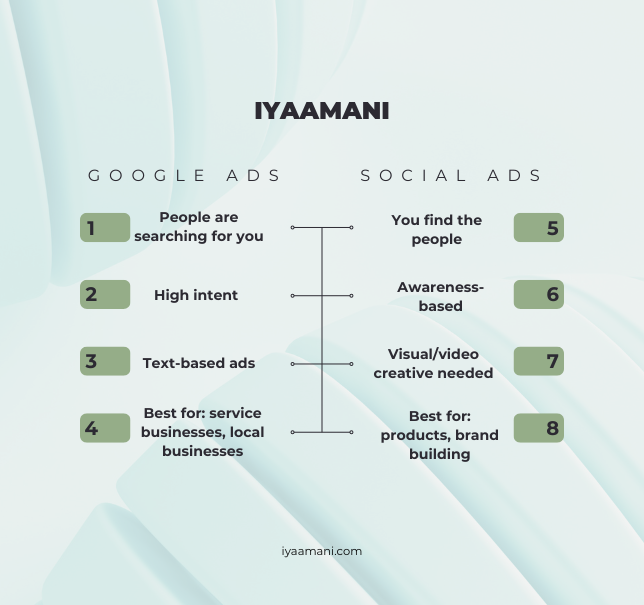
Google Ads reaches people who are actively searching for what you sell. Someone typing “accountant for small business in Dubai” is not casually browsing. They have a problem right now and they want a solution. When your ad appears at that moment, you’re not interrupting them — you’re answering them. That’s a fundamentally different dynamic from social media.
Social ads — Facebook, Instagram, LinkedIn — reach people based on who they are, not what they’re searching for. You’re interrupting their scroll. Your ad appears between someone’s friend’s holiday photo and a meme they didn’t ask for. That doesn’t mean social ads don’t work. They work very well for building awareness and reaching people who don’t know they need you yet. But they require stronger creative to stop someone mid-scroll.
For a small business starting from zero with a limited budget: if people are actively searching for what you do, start with Google Ads. If you’re building awareness for something people don’t know they need yet, start with social. And if you’re not ready to spend on ads yet, building your organic presence through SEO first is a smarter starting point than paying for traffic you haven’t earned yet.
And if you boosted a post and got nothing — that wasn’t a paid ads failure. That was a post boost. Boosting posts is not advertising. It’s paying for reach without any control over who sees it or what they do next. Real social advertising starts in Ads Manager, not the Boost button.
Budget Reality: What You Actually Need to Spend
Nobody wants to hear this, but here it is anyway.
There is no magic number that guarantees results. But there is a minimum below which you won’t collect enough data to know what’s working — and you’ll end up blaming the platform when the real problem was never giving the campaign enough room to breathe.
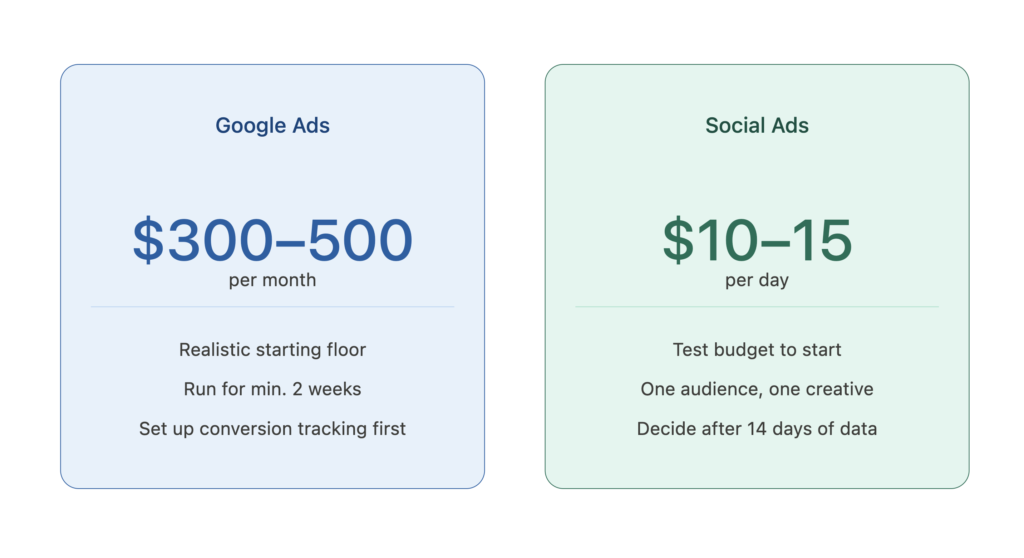
For Google Ads in 2026, the smallest monthly budget where you start seeing meaningful, repeatable returns is around $200 to $300 — and even that is increasingly rare as cost-per-click continues to rise. In competitive markets, treat $300 to $500 per month as your realistic starting floor if you want data you can actually learn from.
For social ads, you can start smaller. Ten to fifteen dollars per day is enough to test a single audience with a single piece of creative. But run it for at least two weeks before drawing any conclusions. Anything less and you’re making decisions based on noise, not signal.
The mindset shift that matters most: your first month of ads is not an investment in customers. It’s an investment in information. You’re buying data — finding out which audiences respond, which messages land, which pages convert. If you go in expecting customers and get data instead, you’ll feel like you failed. If you go in expecting data, you’ll feel like you learned. Same result. Completely different relationship with the outcome.
Paid Ads for Beginners: Mistakes That Drain Budget Fast
These are the four mistakes that kill most beginner campaigns. Not because the business owner isn’t smart — but because nobody told them about these before they hit publish.
Sending traffic to your homepage. Your homepage is built to explain who you are to someone with time to browse. A paid ad visitor arrived because of one specific promise — your ad — and they want that promise fulfilled immediately. If your ad says “free consultation for small business owners” and they land on a general page about everything you do, they’ll leave in ten seconds. Create a dedicated landing page that matches the exact message of the ad. One promise. One action. One outcome.
Broad keywords without boundaries. In Google Ads, broad match keywords will serve your ad to searches that have nothing to do with your business. You pay for every click whether it converts or not. Use phrase match or exact match when starting out, and build a negative keyword list from day one — specific terms you never want to trigger your ads.
No conversion tracking. This is the most damaging mistake of all. Without proper tracking set up before your campaign goes live, Google optimises for clicks instead of results — and clicks do not equal customers. You need to tell Google what a successful outcome looks like: a form submission, a phone call, a purchase. Without this signal, you’re flying blind. And so is the algorithm. Setting up conversion tracking connects directly to understanding your website data overall — if you haven’t set up Google Analytics properly yet, that’s the place to start before your first campaign goes live. Google’s own conversion tracking setup guide walks you through exactly how to do it — it takes about 20 minutes and it’s free.
Giving up too early. Google’s algorithm needs approximately one to two weeks and around 30 to 50 conversion events before it starts to optimise meaningfully. Most beginners pause their campaigns at day five because the early numbers look poor. That’s exactly when the system is still learning. Patience at the start isn’t optional — it’s part of the strategy.
Campaign Structure Basics: The Simplest Setup That Works
You don’t need a complex account structure to start. Most small businesses overcomplicate this immediately and end up with ten campaigns and no idea which one is responsible for any result.
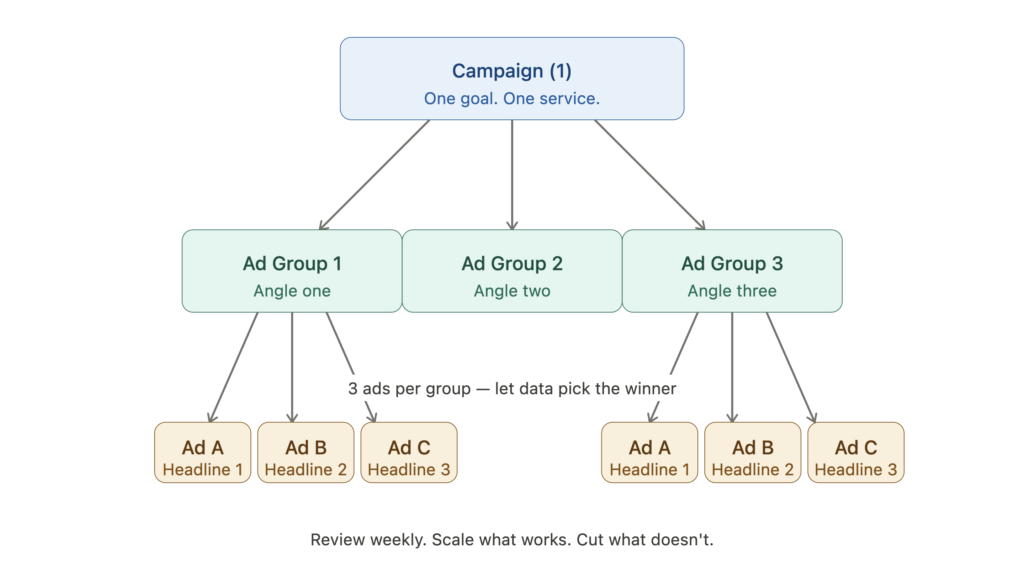
Start with one campaign. One goal. One audience.
Pick the one service or product that is most profitable or most in-demand. Build your first campaign entirely around that — not everything you offer.
Inside that campaign, create two or three ad groups, each targeting a slightly different angle on the same service. If you’re a business coach, one ad group might target “business coaching for startups,” another “one-on-one business coaching,” another “business coach for small business owners.” Each angle attracts a slightly different type of searcher — and over time you’ll see which angle performs.
Inside each ad group, write three ads with slightly different headlines and descriptions. Let them run simultaneously and let the data decide which version people respond to. Don’t guess. The clicks will tell you.
Review the campaign once a week, not every day. Daily checking leads to panic-based decisions made on too little data. Weekly reviews give you enough to spot real patterns without overreacting to normal fluctuation.
The Mindset That Changes Everything
Most small business owners approach paid ads like a slot machine — put money in, hope something comes out. That’s why most beginner campaigns fail. Not because the platform doesn’t work, but because the expectations are wrong.
The right approach treats every campaign as an experiment. Every ad is a question: does this message, shown to this audience, on this platform, produce a result worth the cost? Sometimes yes. Sometimes no. Either way, you learned something. And the business that learns fastest is the one that grows most consistently.
A failed ad is not money wasted. It’s proof that a particular combination didn’t work — which tells you exactly what to try differently next time. Done right, businesses earn an average of $2 for every $1 spent on paid advertising. Done wrong, the budget disappears into irrelevant clicks. The difference is always in the setup — the targeting, the tracking, and the page people land on.
Small budgets. Clear data. Safe scaling. If you want to understand how paid ads fit into the full picture of growing a business online, this beginner’s guide to digital marketing shows where ads sit alongside SEO, content, and branding — and in what order they typically make sense.
Start small enough that a bad month doesn’t hurt you. Learn what the data shows. Scale what works. Cut what doesn’t. Repeat.
That’s not complicated. But it’s the model that works when everything else hasn’t.
A Question Before You Go
Every business is in a different place with paid advertising right now. Some have never run a campaign, they spent money and walked away confused. Some are running ads right now and not sure if the setup is right.
Where are you — and what’s the one thing about paid ads that still feels unclear or too risky to try?
Drop it in the comments. I read every one and I’ll answer you directly.
If you want a second pair of eyes on your current ad setup — or want to think through which platform makes sense for your business before spending anything — let’s talk. No pressure. Just a straight conversation about what makes sense for where you are right now.